
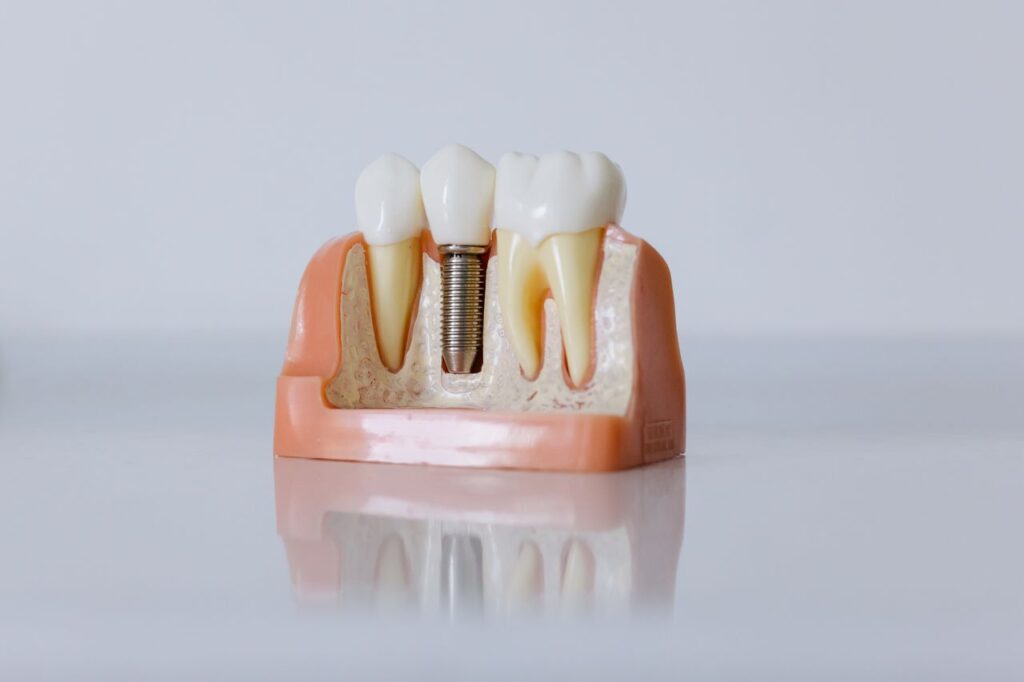
No, dental implants almost never set off airport metal detectors or full-body scanners. Implants are made of titanium or zirconia, they’re tiny, and titanium isn’t magnetic, so security equipment rarely picks them up. Dental implants are also generally safe in MRI machines, though they can slightly distort images of the jaw area. If you’re planning or already have dental implants, travel and medical scans shouldn’t be something you worry about.
This question comes up more than you’d think, usually right before a big trip. People picture alarms going off at Pearson while a line of travellers stares. That really doesn’t happen with dental implants.
Implants are part of restorative dentistry: they replace the root of a missing tooth and support a crown, bridge or denture. Because they sit in the jawbone and are made of biocompatible materials, they’re designed to stay put quietly for decades.
At Celina Dentistry, a premium dental clinic in North York, we get lots of practical implant questions like this one. Can I fly? Can I get an MRI? Will anyone know? The short answers are yes, yes and no.
If an implant crown ever feels loose while you’re travelling or just before a trip, our emergency dentist in Toronto service offers same-day appointments. You can also request an appointment online for an implant consultation or check-up.
What are dental implants made of?
A dental implant is a small screw-shaped post, usually made of titanium or titanium alloy, or sometimes zirconia ceramic, that is placed in the jawbone to replace a tooth root.
| Material | Metal? | Magnetic? | Notes |
|---|---|---|---|
| Commercially pure titanium | Yes | No | Most common, decades of research |
| Titanium alloy | Yes | No | Slightly stronger, very common |
| Zirconia | No (ceramic) | No | Metal-free, tooth-coloured option |
A single implant weighs less than a gram. The crown on top is usually porcelain or zirconia, sometimes with a small titanium connector called an abutment.
Why don’t implants set off metal detectors?
Walk-through metal detectors work by sensing changes in a magnetic field caused by conductive metal objects. Detection depends on the metal type, size and shape. A belt buckle or a set of keys has far more conductive mass than a dental implant.
Titanium is a relatively poor conductor compared with steel, and an implant’s small size inside dense jawbone makes it very hard to detect. Full-body millimetre-wave scanners look for objects on the surface of the body, not inside bone, so implants don’t show up there either.
What about hand-held wands?
A wand held right up to your face could occasionally beep with a larger implant bridge or a full-arch restoration with a metal framework. If that happens, simply tell the security officer you have dental implants. It’s a routine explanation, and they hear similar things about joint replacements every day.
Do you need a card or letter for dental implants when flying?
No. Unlike some hip or knee replacements, dental implants don’t need documentation for security. Some people like to carry their implant information (brand and placement date) for their own records or for dental care while abroad, and that’s a good habit, but it’s optional.
Are dental implants safe for MRI scans?
Titanium and zirconia implants are considered safe in MRI machines. They’re non-ferromagnetic, so the magnet doesn’t pull on them or heat them in any meaningful way.
| Dental item | MRI safety | What to do |
|---|---|---|
| Titanium or zirconia implant | Generally safe | Tell the MRI team. May cause some image distortion near the jaw. |
| Porcelain or zirconia crown | Safe | No action needed |
| Metal-based bridge or crown | Usually safe | Tell the MRI team |
| Magnet-retained overdenture | Magnets can interfere | Remove the denture. The magnetic keepers on implants may need assessment. |
| Removable partial denture with metal clasps | Usually removed | Take it out before the scan |
Always mention dental work on your MRI screening form. Radiologists may adjust settings if they need clear images of your face, sinuses or brain.
What about dental X-rays and CT scans?
Implants show up clearly on X-rays, which is exactly what we want. Dental X-rays let us check the bone around each implant over time. Implants can cause small bright streaks on CT scans, but they don’t affect safety.
Is travelling safe right after implant surgery?
Metal detectors aren’t the concern after surgery. Healing is. Here’s a general guide:
- Simple implant placement: most people can fly 2 to 3 days later.
- Bone graft or sinus lift: often wait 1 to 2 weeks, since cabin pressure changes can affect the sinus area.
- Sedation: don’t travel alone, drive or fly for at least 24 hours.
- Long trips: plan your follow-up visit before you go.
Implants vs bridges vs dentures: what matters for daily life?
| Option | Metal detector issue? | Daily life |
|---|---|---|
| Dental implant | Essentially none | Feels and works like a natural tooth |
| Fixed bridge | Essentially none | Needs special flossing under the bridge |
| Removable denture | None, though metal frames may be noticed by a wand | Removed for cleaning and sleeping |
Myths about implants, pain and anxiety
“Implants are magnetic.”
Titanium and zirconia aren’t magnetic. Fridge magnets won’t stick to your smile, sadly.
“Implant surgery is extremely painful.”
Implant placement is done under local anesthetic, with sedation available. Many patients say recovery felt easier than a tooth extraction, with soreness lasting a few days.
“Implants can be rejected like an organ.”
Titanium and zirconia don’t trigger the kind of immune rejection seen with organ transplants. Implants can fail, usually because of infection, smoking, poor bone healing or overload, not rejection.
Typical patient scenarios
The frequent flyer. A sales manager with 3 implants flies weekly for work. Not one alarm in 4 years, and no one at security has ever asked.
The MRI appointment. A patient with 2 implants needed a brain MRI. They listed their implants on the screening form, the scan went ahead and the images were clear.
The magnet denture. A patient with a magnet-retained lower denture was scheduled for an MRI. We confirmed which parts to remove and gave a note for the imaging team.
Common mistakes implant patients make
- Forgetting to list dental implants on medical imaging forms
- Booking a long-haul flight the day after a sinus lift
- Skipping cleanings and implant check-ups while travelling a lot
- Not packing interdental brushes for trips
- Ignoring a loose implant crown until after a long vacation
Contact your dentist if an implant crown feels loose, the gum around an implant bleeds, swells or tastes bad, or you notice pain when chewing. An implant that moves needs prompt assessment. This article is general information and isn’t a substitute for professional advice.
How to care for dental implants at home and on the road
- Brush twice a day with a soft brush, paying attention to the gumline
- Clean around implants daily with interdental brushes, implant floss or a water flosser
- Pack a travel kit with a brush, floss or picks and a small mirror
- Wear a night guard if you grind
- Keep implant check-ups and cleanings every 6 months, or as recommended
Choosing a dentist in North York for dental implants
Look for 3D imaging, careful planning, clear explanations of materials and a solid maintenance plan. Make sure your dentist is registered with the Royal College of Dental Surgeons of Ontario (RCDSO).
Celina Dentistry is a premium dental clinic in North York at 500 Wilson Ave Unit 108, North York, ON M3H 0E5. We combine artistry with dental excellence, advanced technology and personalized care, in a refined, welcoming space designed around your comfort.
We welcome new patients and provide dental implants, veneers, cosmetic and restorative dentistry, teeth whitening and emergency care with same-day appointments. Every plan focuses on natural-looking results and long-term oral health.
Call +1 647-905-7372 or email info@celinadentistry.ca to book your implant consultation.
What does dental implant treatment involve, step by step?
- Consultation and 3D scan. We check bone height and width, nearby nerves and sinuses, and talk through your goals.
- Treatment plan. Number of implants, materials, whether grafting is needed and what you’ll wear while healing.
- Extraction and grafting, if needed. Sometimes done on the same day as implant placement.
- Implant placement. Under local anesthetic, often guided by a surgical template made from your scan.
- Healing (osseointegration). Usually 2 to 4 months while bone bonds to the implant.
- Abutment and crown. A digital scan, then the final crown is attached and your bite is adjusted.
- Maintenance. Regular cleanings and X-rays to keep the gum and bone around the implant healthy.
Signs you might be a good candidate for implants
- You have one or more missing teeth, or a tooth that can’t be saved
- Your gums are healthy, or gum disease is under control
- You have enough jawbone, or are open to grafting
- You don’t smoke, or are willing to stop during healing
- Your general health allows minor oral surgery
- You’d prefer a fixed option over a removable denture
Health conditions like diabetes don’t automatically rule you out. They just need to be well managed and planned for.
Is a missing tooth urgent?
Usually it isn’t an emergency, but timing matters. After a tooth is lost, the jawbone in that area begins to shrink within months, and neighbouring teeth can drift into the gap. Planning an implant sooner keeps more options open and often means simpler treatment.
If a tooth was knocked out, though, that is an emergency. Keep it moist in milk, avoid touching the root, and get to a dentist within an hour if possible. Sometimes it can be put back.
What about smart watches, fitness trackers and other electronics?
Implants don’t interfere with phones, headphones, smart watches, induction cooktops or electric toothbrushes. They’re passive pieces of metal or ceramic with no electronics inside, so nothing to charge, pair or update.
Frequently asked questions
Will my dental implant beep at airport security?
Almost never. Dental implants are too small and the wrong type of metal to trigger walk-through detectors, and body scanners do not see inside bone.
Are titanium dental implants magnetic?
No. Titanium is not magnetic, which is why implants are considered safe for MRI scans and do not attract magnets.
Can I have an MRI with dental implants?
Yes, in most cases. Tell the MRI team about your implants. Magnet-retained dentures should be removed, and implants may cause some image distortion near the jaw.
Do zirconia implants contain metal?
No. Zirconia implants are ceramic and metal-free, which some patients prefer for personal or aesthetic reasons.
How soon can I fly after getting dental implants?
Many people fly 2 to 3 days after simple implant placement. After a sinus lift or bone graft, waiting 1 to 2 weeks is often advised.
Conclusion
Dental implants are made of non-magnetic titanium or ceramic zirconia, so they rarely trigger metal detectors and are generally MRI-safe. Just mention them on medical imaging forms. With good daily care and regular check-ups, implants let you travel and live without a second thought.